Top Home Design Trends for 2026 Explained
457 views
A room can look beautiful in a photograph and still be annoying to live in.
That oversized sofa blocks the walkway. The open shelving collects dust faster than expected. A pristine white kitchen looks great for three weeks, then suddenly every appliance, cable, and coffee mug becomes part of the visual clutter.
That tension—between how a home looks and how it actually works—is shaping home design in 2026.
The strongest trends aren't simply about a new paint color or a fashionable furniture shape. Designers and homeowners are rethinking privacy, flexibility, wellness, accessibility, outdoor living, storage, and the relationship between technology and the rooms around it. Houzz's 2026 research describes a similar shift toward warmth, longevity, rich materials, heritage details, and spaces designed around real life rather than novelty.
For Room Trends, that makes this year's design story more interesting than a simple list of fashionable interiors. Here are the ideas worth watching—and, more importantly, the ones that can actually improve a home.
1. Rooms Are Becoming More Private and Purposeful
The giant open-plan room had a very long run.
Now the pendulum is moving slightly back.
That doesn't mean walls are suddenly replacing every open kitchen and living area. Instead, homeowners are creating smaller zones within larger spaces: a reading corner, a proper dining area, a quiet work nook, or a room that can be closed off when somebody needs concentration.
Architectural Digest's 2026 designer forecast describes homes becoming more multipurpose, including dedicated spaces for activities that previously happened wherever there happened to be an empty chair.
The practical lesson is simple: design for activities, not just square footage.
A 12-foot-long kitchen island isn't automatically better than a smaller one if it leaves nowhere comfortable for conversation. Likewise, an open home office can become frustrating when meetings, television, cooking, and household traffic all happen within earshot.
Pocket doors, partial-height partitions, curtains, built-in shelving, and strategically positioned furniture can create separation without making a home feel boxed in.
2. Curves Are Moving From Furniture Into Architecture
Curved sofas aren't the only rounded element showing up anymore.
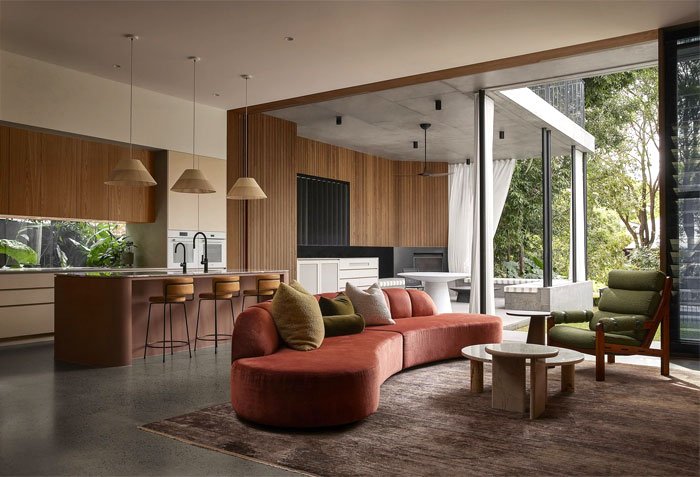
Arched doorways, curved islands, scalloped details, wave-shaped tile, rounded cabinetry and softer architectural transitions are gaining attention. Houzz's May 2026 emerging-trends report found searches for scalloped tile had increased more than threefold, while searches for wave tile rose 38%. Searches for arched range hoods climbed 177%, and arched pantry doors rose 130%.
That's a surprisingly strong signal.
The trick is restraint. A curved doorway can feel architectural and intentional; putting a rounded edge on every cabinet, table and lamp can quickly make a room look themed.
For an existing home, the easiest entry point is usually furniture. Try one curved sofa, an oval coffee table, or a rounded accent chair before committing to expensive construction.
3. Warmth Is Replacing the Cold Minimalist Look
The sterile white-and-gray interior isn't disappearing completely, but it is losing its monopoly.
Warm wood, earthy neutrals, textured fabrics, stone, aged metals and deeper accent colors are producing rooms that feel less like showrooms and more like places people actually live.
Room Trends has already covered the specific 2026 color movement in depth, including warm khaki, soft whites, clay tones, muted greens and richer reds. The broader design shift goes beyond paint, though.
Material is doing much of the work.
A plain beige wall with a glossy synthetic sofa can still feel cold. Add oak, linen, wool, ceramic, natural stone and layered lighting, and the same color palette suddenly has depth.
Texture is becoming as important as color.
This is also why vintage furniture works so well with contemporary rooms. A scratched wooden side table or old ceramic lamp can introduce visual history that a matching furniture set simply can't reproduce.
4. Hidden Storage Is Getting Smarter
Clutter hasn't become less annoying.
Designers have simply become better at hiding it.
Houzz identifies integrated and concealed features as a major 2026 direction: panel-ready appliances, pocket-door cabinets, concealed range hoods, hydraulic-lift storage, hidden charging stations and lighting integrated into millwork are all being used to preserve clean sightlines.
This is more than minimalist styling.
Consider a kitchen where the refrigerator is covered with matching cabinetry. Or a living room where charging cables disappear into a side table instead of crossing the floor. A television can be concealed behind cabinetry, while a small appliance garage keeps coffee machines and mixers out of sight when they're not being used.
The important detail is accessibility.
Hidden doesn't mean buried. If opening three doors and moving two boxes is required to reach the toaster, the design has technically succeeded and practically failed.
5. Wellness Is Moving Into Ordinary Rooms
You don't need a private spa to design a healthier-feeling home.
A comfortable chair near a window can become a reading retreat. Better ventilation can matter more than an expensive decorative feature. A small exercise zone can make fitness easier to maintain than a dedicated gym that nobody uses.
Houzz reports that searches for “home gym” increased 46% in its 2026 trend data, while searches for “sensory room” rose 43% and “yoga room” increased 20%. The pattern suggests that wellness is becoming broader than simply installing a luxurious bathroom.
The same idea appears in higher-end projects, where designers are incorporating saunas, steam showers, plunge pools, meditation areas and dedicated recovery spaces.
But the most useful wellness upgrades can be much less dramatic:
A quiet room with comfortable seating
Better task lighting
A bedroom with less visual clutter
A place to leave phones outside the sleeping area
Natural ventilation and daylight
Flooring that feels comfortable underfoot
Sometimes the expensive-looking trend has a very ordinary solution.
6. Homes Are Being Designed for More Stages of Life
A beautiful staircase isn't much help if somebody eventually can't use it safely.
Universal and aging-in-place design are becoming less visibly clinical and more integrated into mainstream interiors. Curbless showers, nonslip flooring, wider circulation routes, better lighting and accessible storage can look completely contemporary.
Houzz notes that these features aren't useful only for older adults. They can also help someone recovering from surgery, living with a temporary injury, or raising young children.
That's an important change in thinking.
Instead of remodeling a home after a problem appears, designers can quietly build flexibility into it from the start.
A bathroom with a curbless shower doesn't announce itself as “accessible.” It simply has easier entry. A wider doorway doesn't make a hallway less stylish. A lever handle can be easier for almost everyone to operate.
Good universal design tends to disappear into good design.
7. Outdoor Spaces Are Becoming Real Rooms
The backyard is no longer just the place where the grill sits.
Outdoor areas are increasingly being planned as extensions of indoor living: lounge zones, dining areas, quiet retreats, kitchens, fire features and dedicated garden spaces.
Houzz's 2026 Outdoor Trends Study found that 83% of renovated outdoor spaces included a lounge or seating area, with 71% containing sofas or lounge chairs. Outdoor lighting appeared in 66% of lounge areas.
That's significant because it changes how the entire property is planned.
Instead of buying random patio furniture and arranging it later, think in zones:
Conversation: comfortable seating and a small table.
Dining: weather-resistant table, lighting and convenient access to the kitchen.
Quiet: a chair, lounger or shaded corner away from the main traffic.
Landscape lighting deserves particular attention. Houzz reports that landscape lighting was selected by 80% of homeowners undertaking outdoor renovations in its 2026 study.
A few well-positioned fixtures can make an outdoor space usable long after sunset.
8. Sustainability Is Becoming More Specific
“Eco-friendly” used to be a vague decorating label.
The 2026 version is much more practical.
Houzz reports that searches for solar energy increased nearly eighteenfold, while searches for repurposed materials almost tripled. Interest in permeable patios rose 137%, native landscaping 59%, recycled-glass countertops 84%, and bamboo flooring 32%.
These choices affect the house beyond aesthetics.
Native plants can reduce maintenance demands. Permeable surfaces can help manage rainwater. Reclaimed materials can give interiors character while avoiding the perfectly-new appearance of mass-produced finishes.
Energy performance is part of the design conversation too. Insulation, shading, efficient windows, solar generation and appropriate HVAC systems can influence comfort every day—not just the home's appearance during a property viewing.
9. Technology Is Becoming Less Visible
The smartest room increasingly doesn't look particularly “smart.”
That's because homeowners are tired of technology becoming visual clutter.
Instead of a row of gadgets, expect more integrated controls, concealed speakers, built-in charging points, automated shades and lighting systems that disappear into the architecture.
The same philosophy applies to televisions, appliances and security hardware.
Technology should solve a problem without demanding attention every five seconds.
That principle also helps prevent a home from aging badly. A room built around a particular gadget can feel dated surprisingly quickly; a room built around flexible power, lighting, connectivity and storage can adapt as technology changes.
10. Personal History Is Coming Back
Perfectly coordinated rooms are losing some of their appeal.
Vintage pieces, inherited furniture, handmade objects, travel finds, family photographs and artwork with an actual story are being mixed with newer furnishings. Architectural Digest's 2026 coverage repeatedly points toward richer, more personal interiors, including vintage objects and culturally influenced design details.
This trend is especially useful for homeowners on a realistic budget.
You don't need to replace an entire room.
Keep the good old dresser. Reupholster the chair. Frame something meaningful. Mix one antique piece with a contemporary sofa. Let materials show some age.
A home shouldn't look like every item arrived in the same delivery truck.
How to Use 2026 Trends Without Making Your Home Look Dated
The safest strategy is to separate permanent decisions from replaceable ones.
Permanent changes—flooring, cabinetry, plumbing, doors and major lighting—should be chosen around your home's architecture and your daily habits.
Trendy elements can live in easier-to-change areas: cushions, artwork, lamps, occasional chairs, rugs and smaller decorative pieces.
For example, you might install warm oak cabinetry because it works with the architecture, then introduce a 2026-inspired burgundy chair or sculptural lamp. Five years later, changing the chair is much easier than rebuilding the kitchen.
That's the difference between designing with a trend and designing for a trend.
The first gives a home character. The second can give you a renovation bill.
FAQ
What is the biggest home design trend for 2026?
The biggest shift is toward warmer, more personal and multifunctional homes. Curved forms, tactile materials, hidden storage, wellness spaces and stronger indoor-outdoor connections are all part of that broader movement.
Are open floor plans going out of style in 2026?
Not exactly. The trend is toward more flexible zoning rather than abandoning open layouts completely. Furniture placement, pocket doors, partitions and dedicated activity areas can provide privacy while preserving openness.
Are curved interiors still popular in 2026?
Yes. Houzz's 2026 search data shows strong growth around scalloped, wave-shaped and arched design elements, suggesting that softer geometry is moving beyond furniture into architecture and kitchens.
What is an easy 2026 trend to add without remodeling?
Start with texture and lighting. A vintage side table, curved chair, natural-fiber rug, sculptural lamp or warmer-toned textiles can change the atmosphere without touching walls or cabinetry.
Should I follow every home design trend?
No. The strongest 2026 interiors aren't built from a checklist of fashionable products. Choose trends that improve how you use the room, then leave the rest alone.
A Better Way to Think About Your Next Room
The most interesting home design trend of 2026 may not be a particular color, material or furniture shape.
It's the shift toward homes that work harder for the people living in them.
A curved doorway can soften a space. Hidden storage can remove visual noise. A shaded outdoor lounge can create another living area. Better lighting can change a room every evening. Universal-design details can quietly make the house more useful for years.
Start there.
Before buying anything, watch how the room behaves for a week. Notice where people naturally sit, where clutter accumulates, where sunlight becomes uncomfortable, where cables end up, and which spaces nobody uses.
Then design around those observations.
That approach won't become obsolete when the next trend report arrives.
home design trends 2026
room design ideas
modern home interiors
sustainable home design
smart room layouts
Found this helpful? Share it!