
Living Room Layout Ideas for Small & Large Spaces
407 views
A living room can have beautiful furniture and still feel completely wrong.
You know the feeling. The sofa technically fits, but someone has to squeeze past it to reach the door. The coffee table looks perfect in the showroom and suddenly feels enormous at home. In a larger room, the opposite problem appears: everything fits, yet the space somehow feels unfinished and strangely empty.
The fix usually isn't another decorative object. It's the layout.
Room Trends already covers broad living-room design mistakes and small-space strategies, so this guide takes a more practical angle: how to build a layout around movement, furniture scale, sightlines, and the way people actually use the room.
Start With the Walking Path, Not the Sofa
The easiest mistake is choosing the sofa first because it's the largest and most expensive piece.
Instead, stand at the room's entrance and imagine the routes people naturally take. Where do they walk from the front door? Does someone cross the seating area to reach the kitchen? Is there a balcony door, hallway, fireplace, or staircase that must remain accessible?
A practical target is 30–36 inches (76–91 cm) for a primary walkway. Around seating and occasional furniture, tighter clearances can work, but a busy route shouldn't feel like an obstacle course. Houzz similarly recommends roughly 2–4 feet for a main walking path and about 15–18 inches between upholstered seating and a coffee table.
Then measure the furniture.
A typical sofa is roughly 84 inches long and 38 inches deep, according to Houzz's living-room measurement guide. That's already a substantial footprint before you add a coffee table, chairs, rug, side tables, and circulation space.
Empty floor isn't wasted space. It is part of the layout.
Before buying anything, use painter's tape to mark the proposed sofa, chairs, and table directly on the floor. Walk around the taped shapes. Open nearby doors. Sit where the sofa would be. It's surprisingly effective, and it can save you from discovering that your "perfect" sectional blocks the only sensible route through the room.
Small Living Rooms Need Fewer, Better Pieces
A compact room doesn't necessarily need tiny furniture.
That's a common misconception.
Using six miniature pieces can make a room look busier than using three appropriately scaled ones. The goal is to reduce the number of visual and physical obstacles while keeping enough seating for the people who actually use the room.
Try a compact conversation arrangement
For a narrow apartment living room, a loveseat against one wall with one or two lightweight lounge chairs opposite it can work beautifully. If the chairs have slim frames or exposed legs, more of the floor remains visible.
Another option is a sofa plus one swivel chair. The chair can face the sofa for conversation, then rotate toward a television or window when needed.
That flexibility matters in small rooms.
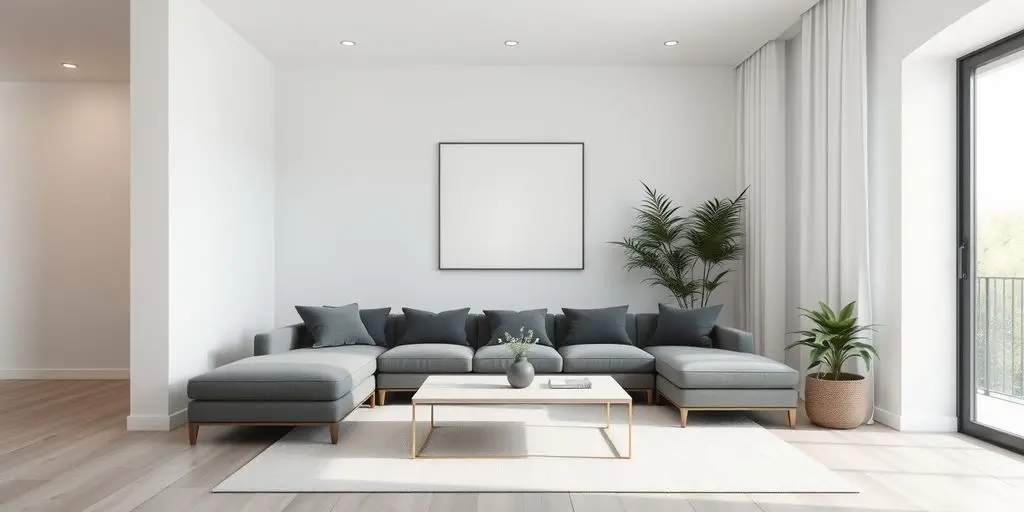
A bulky sectional can work, too, but only if its dimensions leave usable circulation. IKEA's current sofa-layout guidance also highlights L-shaped arrangements as useful for creating seating while maintaining a defined orientation toward a TV or focal point.
Swap fixed furniture for flexible furniture
A storage ottoman can act as a footrest, extra seat, and concealed storage.
Nesting tables can separate when guests arrive and stack when they don't. A small round coffee table can make circulation easier because there are no sharp corners projecting into a walkway.
For particularly tight rooms, don't assume a conventional rectangular coffee table is mandatory.
The better question is: What furniture gives me the most useful function per square foot?
The Coffee Table Gap Is Smaller Than You Think
People often push coffee tables too far away because the arrangement looks spacious in photographs.
Then they sit down and discover they have to lean forward every time they want a drink.
A widely used guideline is approximately 14–18 inches (36–46 cm) between the sofa and coffee table. Homes & Gardens cites the same range, noting that it balances reachability with comfortable legroom.
Don't treat 18 inches as a law carved into stone. A particularly deep sofa, a low table, children running through the room, or a secondary circulation route may justify changing it.
Measure the actual furniture.
A 16-inch gap can feel generous with one sofa and surprisingly tight with another.
Let the Room's Focal Point Decide the Orientation
Every living room has something that naturally attracts attention.
It might be a fireplace. A television. A large window. A dramatic artwork. Sometimes it's simply the best view outside.
Arrange the seating around that feature, but don't automatically make the TV the center of existence.
If the room is mainly used for conversation, two sofas facing each other can be more comfortable than lining every seat toward a screen. Houzz recommends identifying the room's focal point before positioning furniture and notes that seating should support conversation rather than simply hug the walls.
For a TV-focused room, viewing distance still matters, but don't sacrifice the entire circulation plan just to center a sofa perfectly with the screen.
A living room has to work when nobody is watching television.
Large Living Rooms Need Zones, Not More Furniture
Large rooms create a different headache.
You have space. Too much of it.
A single sofa sitting against one wall with a giant empty area in front often makes the furniture look undersized. Adding random chairs won't necessarily solve it.
Create separate functional zones instead.
One end might contain the main sofa and television. Another can hold two comfortable chairs and a small table for conversation. Near a window, a reading chair and floor lamp can create a quieter corner.
The zones don't need physical walls.
A rug can establish one. A sofa back can establish another. A console table, bookcase, lighting arrangement, or change in furniture orientation can subtly divide the room without destroying its openness.
This is particularly useful in open-plan homes, where furniture has to create boundaries that architecture doesn't provide.
Float the furniture
Large rooms are where floating furniture becomes especially valuable.
Pulling a sofa away from the wall can create a more intimate seating area and leave room behind it for a console or circulation route. IKEA specifically recommends leaving some space behind a sofa when the room allows it, rather than automatically treating every wall as a furniture boundary.
The difference can be dramatic.
A sofa floating 12–24 inches from a wall can suddenly make a huge room feel designed rather than sparsely furnished.
Long, Narrow Rooms Need a Different Strategy
Long rooms are awkward because the obvious arrangement often exaggerates their length.
Putting every piece of furniture along the long walls creates a corridor effect.
Instead, consider dividing the room into two connected areas. A sofa and television might occupy one section while a pair of chairs, a small table, or a compact desk occupies the other.
Use a rug to visually establish each zone.
Keep the main route running alongside or between the zones rather than forcing people to walk directly through the middle of a conversation area.
If doors sit at opposite ends, this becomes even more important. The shortest path between those doors should remain obvious.
Square Rooms Benefit From Balance
Square rooms naturally lend themselves to symmetrical arrangements.
Try a sofa facing two chairs, with a coffee table centered between them. Another option is two sofas facing each other, particularly if conversation is more important than television viewing.
A U-shaped arrangement can work beautifully in a genuinely spacious square room, but don't force it into a compact one. IKEA notes that U-shaped seating is best suited to rooms with enough space; otherwise, the arrangement can quickly become cramped.
Symmetry isn't mandatory, either.
A sofa on one side balanced by two chairs on the other can provide visual weight without making the room look overly formal.
Use the Rug to Connect the Furniture
A rug shouldn't look like an island floating underneath the coffee table.
In a properly planned seating area, at least the front legs of the main upholstered pieces can sit on the rug, helping visually connect the sofa and chairs into one composition.
Large rooms often need a larger rug than homeowners initially expect. A tiny rug in the center of a huge seating arrangement makes the furniture look disconnected.
In a small room, though, don't buy the biggest rug simply because someone called it a "rule." Measure the seating footprint first.
The rug should support the arrangement—not dictate it.
Lighting Can Fix a Layout That Feels Flat
Furniture placement determines physical flow. Lighting determines how the room reads at night.
A sofa may be perfectly positioned but still feel dull if the only light source is a ceiling fixture.
Build layers.
Use a floor lamp beside a reading chair, a table lamp near a sofa, and wall lighting where appropriate. In a larger room, separate lighting by zone so the entire space doesn't have to be illuminated equally.
This also gives you a useful trick: lighting can reinforce boundaries without adding furniture.
Turn on the reading lamp and that corner becomes a reading zone. Light the seating area and the rest of the room recedes slightly.
Don't Forget the Television, Windows, and Real Life
A layout can look fantastic from one camera angle and be miserable to live with.
Check the room from the sofa.
Can you see the TV without twisting your neck? Does sunlight create glare during the afternoon? Can someone walk behind the sofa without bumping into it? Does a cabinet door open fully? Can you reach a power outlet?
These tiny frustrations become obvious after a week.
IKEA's living-room planning examples specifically account for competing activities such as television watching and gaming, showing how seating and furniture can support different uses rather than forcing everyone into one viewing position.
That idea scales well beyond gaming.
Your living room might need to support reading, working, entertaining, relaxing, and watching television on the same day.
Design for that reality.
A Simple Layout Test Before You Buy Anything
Try this two-step process:
Tape the furniture footprint. Mark the exact length and depth of the sofa, chairs, tables, and major storage pieces on the floor.
Live with the empty outline. Walk the routes, open doors, sit in the intended positions, and check sightlines at different times of day.
If the taped sofa already feels too large, the real sofa won't magically become smaller.
And measure the delivery route too. The front door isn't necessarily the hardest obstacle. Hallways, stairwells, elevator doors, tight turns, and apartment entrances can all stop an oversized piece before it reaches the living room. Current design guidance repeatedly emphasizes measuring entry points before purchasing large furniture.
Small vs. Large: Which Layout Strategy Fits?
Room situation | Strong starting point | Watch out for |
|---|---|---|
Small apartment | Loveseat + one or two flexible chairs | Oversized sectional |
Long, narrow room | Two functional zones | Furniture lined along every wall |
Square room | Sofa + opposing chairs | Overcrowding the center |
Large open room | Multiple seating zones | One tiny furniture cluster |
TV-focused room | Seating oriented toward screen | Blocking circulation |
Conversation-focused room | Facing sofas or chairs | Everyone facing one direction |
The best arrangement isn't necessarily the one that photographs best.
It's the one that still works on an ordinary Tuesday evening.
Frequently Asked Questions
How much space should be between a sofa and coffee table?
Start around 14–18 inches. That range usually provides comfortable legroom while keeping the table close enough to reach. Adjust it for the actual furniture and traffic pattern.
How wide should a living room walkway be?
For a primary circulation route, aim for roughly 30–36 inches. A heavily used route may benefit from the wider end of that range, particularly when multiple people regularly pass through it.
Should a sofa always touch the wall?
No. If the room allows it, pulling the sofa away from the wall can create depth and make a large room feel more intimate. In very small rooms, however, placing the sofa against a wall may be the most sensible use of space.
What's the best layout for a small living room?
Start with the fewest pieces that satisfy the room's needs. A compact sofa or loveseat paired with one or two flexible chairs often gives you more usable circulation than a bulky sectional.
How do you make a large living room feel less empty?
Stop trying to fill the entire floor with furniture. Create two or more purposeful zones using seating, rugs, lighting, and storage. The room should feel connected, not packed.
Make the Layout Work Before Making It Pretty
The strongest living room layouts aren't built by copying a photograph.
They start with measurements, movement, focal points, and the habits of the people who actually live there. Small rooms usually need restraint and flexibility; large rooms need scale and deliberate zoning. Both benefit from the same discipline: give every major piece a reason to be where it is.
Before ordering that new sofa, grab a tape measure and some painter's tape. Mark it out. Walk around it. Sit down in the imaginary seat.
If the room works while it's still just tape on the floor, you're already most of the way there.
living room layout ideas
small living room design
large living room layout
room arrangement ideas
living room decor tips
Found this helpful? Share it!